This project involved the product strategy, system architecture, and full implementation of a custom API bridge connecting BigCommerce with Michaels Marketplace. The solution introduced a controlled automation layer capable of selective SKU publishing, taxonomy translation, structured data validation, incremental inventory synchronization, image optimization, and operational error handling.
The architecture was built as a microservice-based integration layer designed to manage marketplace-specific constraints, including strict category mapping, GTIN compliance requirements, approval workflows, and data formatting rules. Admin-facing controls were implemented to allow selective publishing and human review when automated matching confidence fell below defined thresholds.
Enable scalable expansion into new marketplace channels without adding operational complexity or manual workload.
With over 5,000 SKUs managed in BigCommerce, manually listing and maintaining products on external marketplaces would introduce significant ongoing labor, duplication of work, and high risk of data inconsistencies. Michaels Marketplace was the first additional channel, but the long-term goal was to enable scalable multi-channel expansion. However, marketplace platforms operate with different taxonomies, data requirements, compliance rules, and publishing workflows. Without a centralized integration layer, each new marketplace would require manual uploads, separate data formatting, and repetitive maintenance.
I designed and implemented a custom API bridge that positioned BigCommerce as the single source of truth while enabling selective, automated publishing to Michaels Marketplace. The system introduced controlled SKU selection, taxonomy translation, structured data validation, GTIN compliance handling, and incremental inventory synchronization. The architecture was designed as a scalable automation layer that could support future marketplace additions.
This phase established the architectural and operational framework for scalable marketplace integration. Through API analysis, constraint modeling, and system design, the integration strategy was defined to ensure compliance, reliability, and long-term extensibility beyond a single marketplace.
A blueprint was produced to visually represent the core microservice sequences and logic flows.
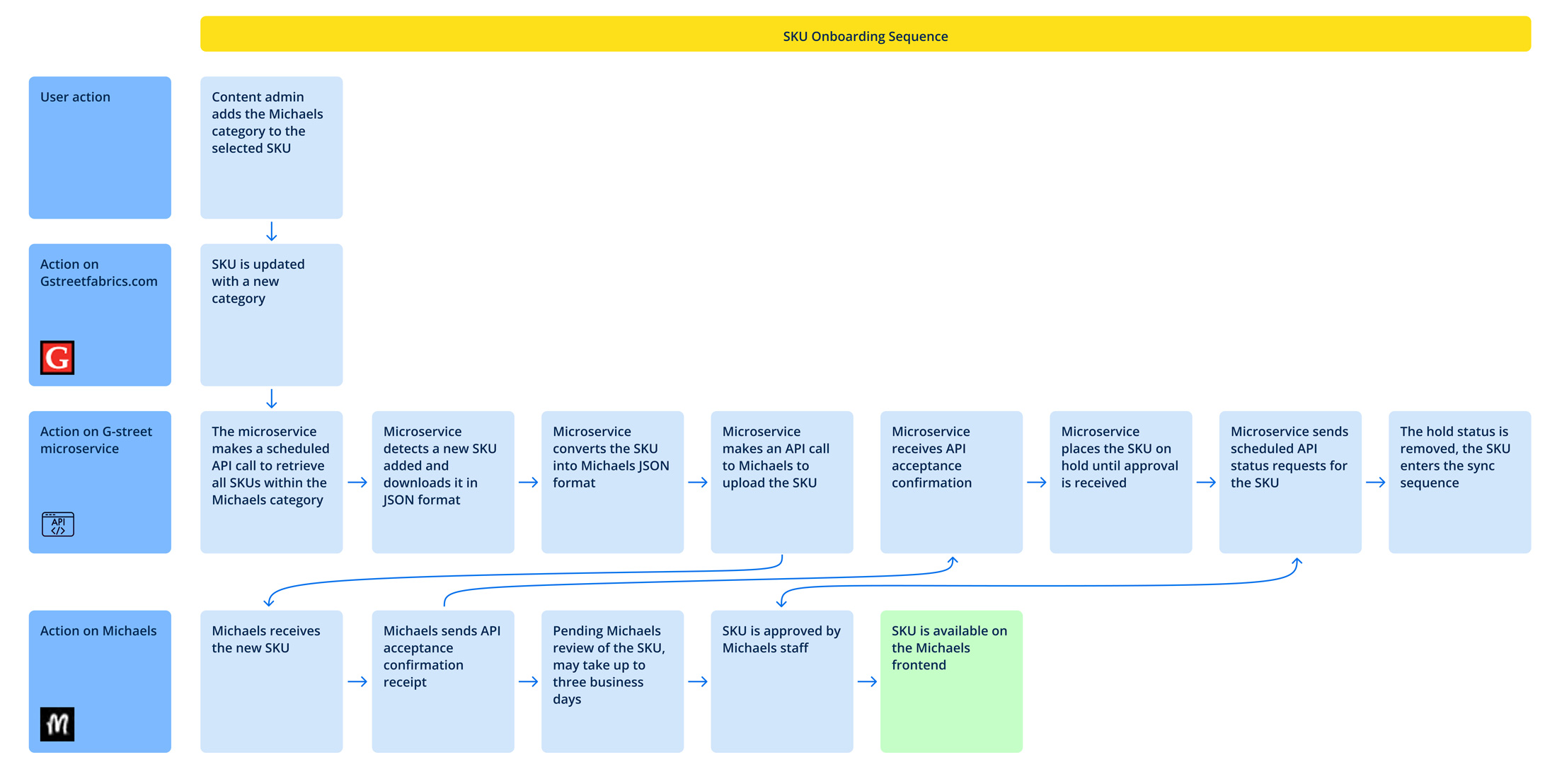
To support the custom microservice, I evaluated hosting environments based on security, scalability, cost efficiency, and compatibility with the system’s technical requirements. A cloud based Oracle infrastructure running a LAMP stack was selected, as it met all operational needs including secure API communication, scheduled job execution, environment isolation, and scalable resource allocation.
Two separate environments were configured, development and production, to ensure safe testing, controlled releases, and operational stability. The development environment allowed iterative testing of API logic, taxonomy mapping, and synchronization workflows without impacting live data. The production environment was configured for secure and reliable execution. Authentication handling, logging, and controlled access were implemented to maintain data integrity and long term system stability.
After enabling API access on both platforms, I began testing endpoints and payload structures using Postman to understand data behavior, validation rules, and required attributes. Early testing revealed that Michaels Marketplace enforces significantly stricter data validation rules than BigCommerce. Several required attributes in the Michaels API were either optional or not structured in the same way within BigCommerce.

Some missing data points could be addressed through controlled default values within the transformation layer. However, GTIN requirements presented a critical business constraint. Michaels requires a valid GTIN for every product, while many existing products in BigCommerce did not have this data populated. This was identified as a blocking issue, communicated to the client, and resolved at the business level through the acquisition and assignment of GTINs.
Further data analysis revealed a fundamental taxonomy mismatch. BigCommerce uses a tag based and flexible category structure, whereas Michaels relies on a strict hierarchical path based taxonomy. The two systems are not directly translatable in an automated all to all format without high failure rates.
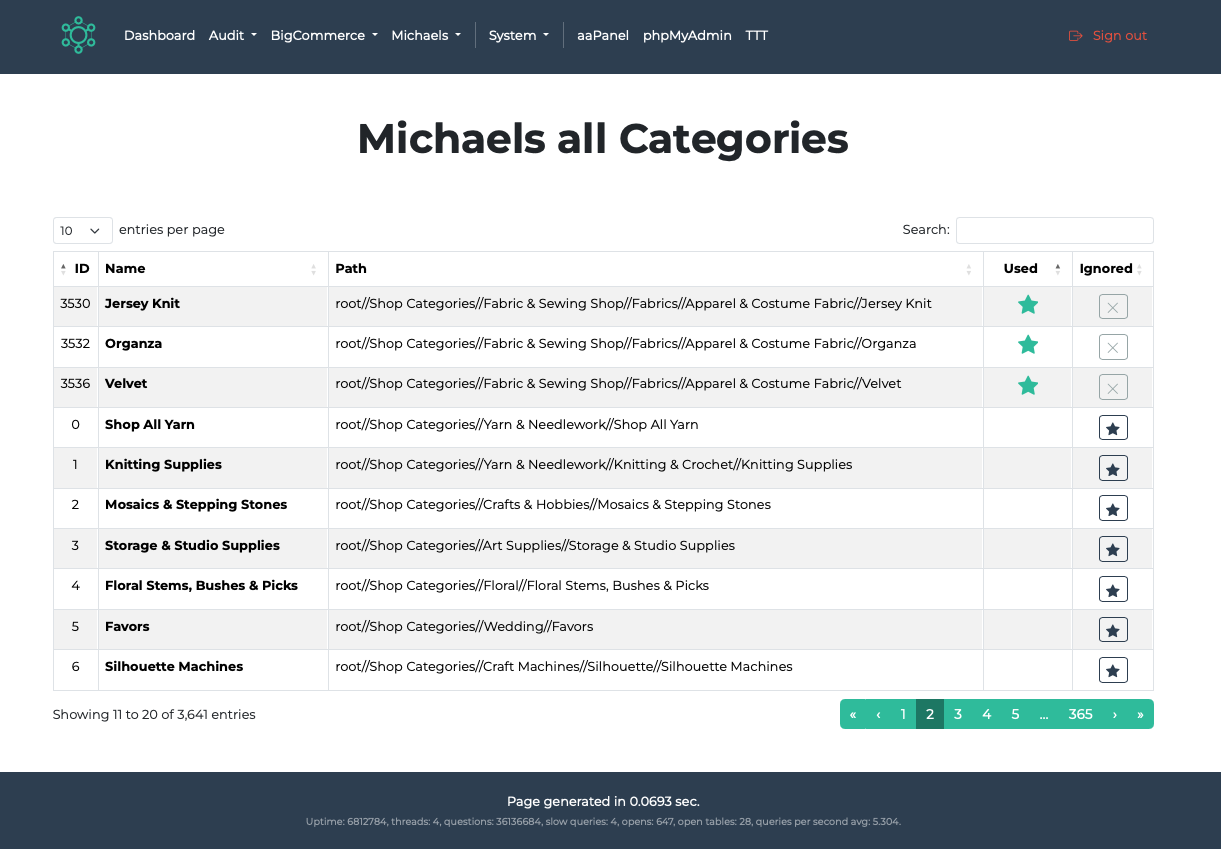
To address this, I designed a controlled category mapping interface that limits the scope of Michaels categories eligible for automated matching. The automation considers only a predefined subset of categories, reducing ambiguity and improving matching accuracy. If the matching algorithm cannot determine a confident result, the SKU is flagged for human review rather than forcing an incorrect assignment. Since the initial rollout focuses exclusively on fabric SKUs, this constraint aligns with business scope while ensuring mapping reliability.
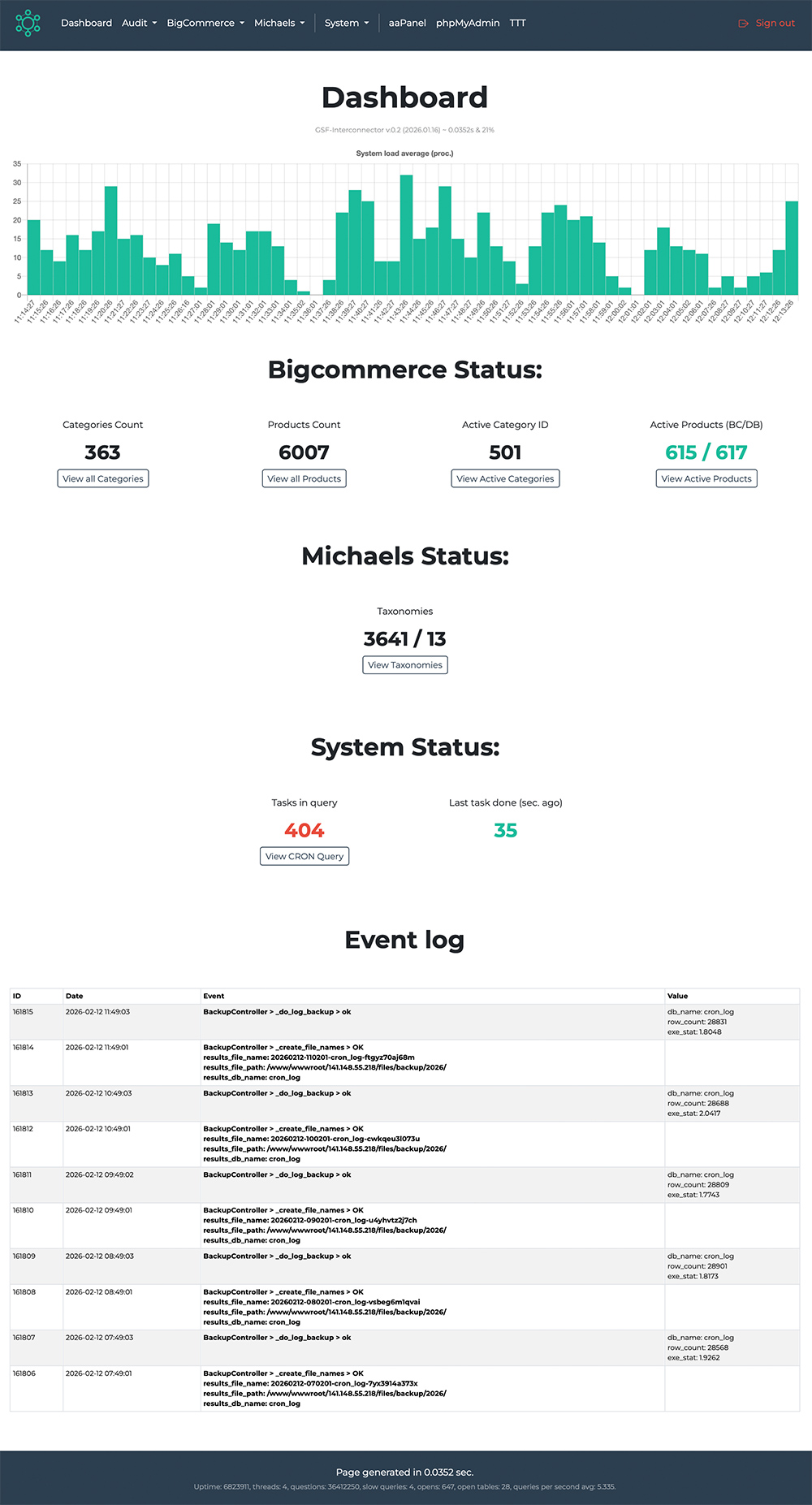
To ensure the integration remained transparent and manageable, a system dashboard was implemented to provide visibility into automation activity and overall integration status. The dashboard presents high level metrics including total product counts, synchronized SKUs, and category distributions across both BigCommerce and Michaels. This allows stakeholders to quickly understand system scope and alignment without relying on manual API checks.
The automation layer includes structured logging for every major operation, including product data transformation, category matching, inventory updates, and API responses. Logs are organized by operation type, making it easier to trace validation issues, rejected payloads, or synchronization inconsistencies.
Automated log archiving mechanisms were implemented to preserve historical traceability while preventing unnecessary data accumulation. This ensures that past synchronization events remain accessible for analysis without impacting system performance.
System health indicators monitor synchronization cycles and API response behavior to detect anomalies such as rate limits, validation errors, or interrupted processes. This visibility framework ensures that automation remains observable, controlled, and auditable, supporting long term scalability.
Security was implemented as a core architectural principle. Communication between the microservice and both marketplaces is restricted to dedicated IP addresses, with traffic limited to explicitly whitelisted endpoints. No external access is permitted outside defined channels. API credentials are securely stored outside application logic, and all communication occurs over encrypted HTTPS connections. The administrative dashboard is protected by role based access control and two factor authentication, with login activity logged for traceability. Server level firewall rules and minimal service exposure reduce the attack surface, ensuring that product data, synchronization processes, and marketplace credentials remain secure.
A detailed analysis of performance metrics, operational efficiency gains, and channel growth outcomes will be published as the data set matures.
© 2026 misunin.com

|

|

|

|

|

|

|

|